
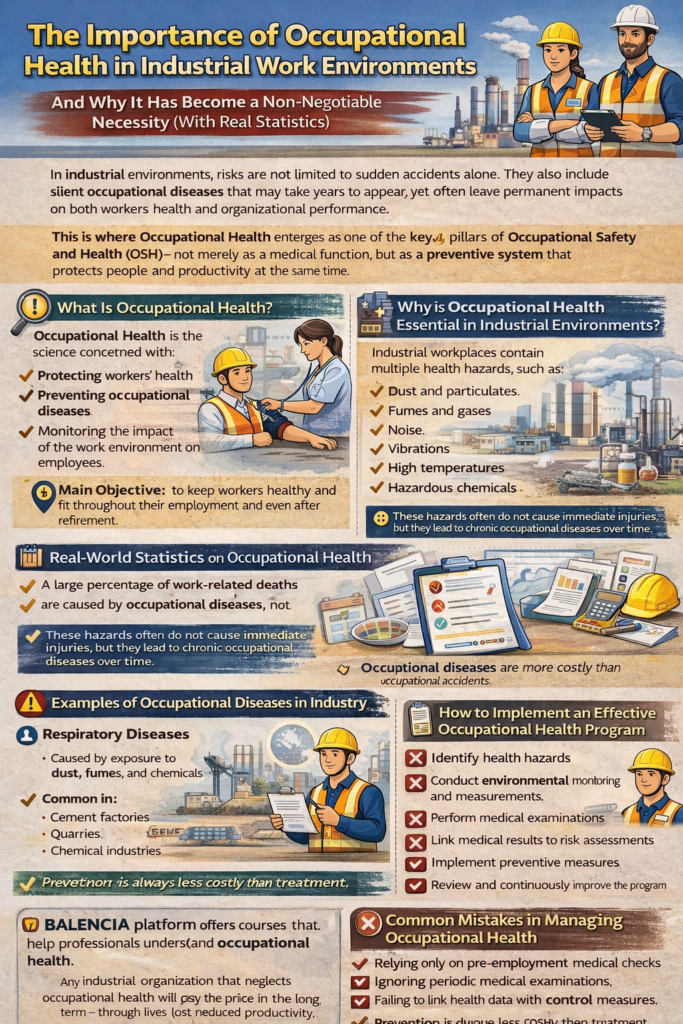
And Why It Has Become a Non-Negotiable Necessity (With Real Statistics)
In industrial environments, risks are not limited to sudden accidents alone. They also include silent occupational diseases that may take years to appear, yet often leave permanent impacts on both workers’ health and organizational performance.
This is where Occupational Health emerges as one of the key pillars of Occupational Safety and Health (OSH)—not merely as a medical function, but as a preventive system that protects people and productivity at the same time.
🔍 What Is Occupational Health?
Occupational Health is the science concerned with:
Protecting workers’ health
Preventing occupational diseases
Monitoring the impact of the work environment on employees
Early detection of any work-related health damage
📌 Main Objective:
To keep workers healthy and fit throughout their employment and even after retirement.
🏭 Why Is Occupational Health Essential in Industrial Environments?
Industrial workplaces contain multiple health hazards, such as:
Dust and particulates
Fumes and gases
Noise
Vibrations
High temperatures
Hazardous chemicals
📌 These hazards often do not cause immediate injuries, but they lead to chronic occupational diseases over time.
📊 Real-World Statistics on Occupational Health
Global professional reports indicate that:
A large percentage of work-related deaths are caused by occupational diseases, not accidents.
Occupational noise exposure is one of the most common causes of acquired hearing loss.
Continuous exposure to dust and fumes increases rates of:
Respiratory diseases
Occupational allergies
Chronic lung diseases
Organizations that implement effective occupational health programs experience:
Reduced sickness absenteeism
Improved productivity
Lower medical treatment and compensation costs
📌 Occupational diseases are more costly than occupational accidents.
⚠️ Examples of Occupational Diseases in Industry
🫁 Respiratory Diseases
Caused by exposure to dust, fumes, and chemicals
Common in:Cement factories
Quarries
Chemical industries
👂 Occupational Hearing Loss
Caused by continuous noise exposure
Common in:
Heavy industries
Workshops
Construction sites
🧴 Occupational Skin Diseases
Caused by oils, solvents, and chemicals
Common in:
Petroleum industries
Mechanical workshops
🛠️ The Preventive Role of Occupational Health
Occupational health does not only treat illnesses—it prevents them through:
Periodic medical examinations
Early detection
Health surveillance
Recommending preventive control measures
📌 Prevention is always less costly than treatment.
📋 How to Implement an Effective Occupational Health Program
To establish a successful program in industrial facilities, organizations should:
1️⃣ Identify health hazards
2️⃣ Conduct environmental monitoring and measurements
3️⃣ Perform medical examinations
4️⃣ Link medical results to risk assessments
5️⃣ Implement preventive measures
6️⃣ Review and continuously improve the program
🚫 Common Mistakes in Managing Occupational Health
Relying only on pre-employment medical checks
Ignoring periodic medical examinations
Failing to link health data with control measures
Depending solely on PPE
Reacting to illness after it occurs
🎓 Why Do Workers Need to Learn Occupational Health?
To understand real health risks
To apply health risk assessment principles
To protect themselves and their colleagues
👉 Balencia platform offers courses that help professionals understand occupational health.
Any industrial organization that neglects occupational health will pay the price in the long term—through lives lost, reduced productivity, and increased costs.