

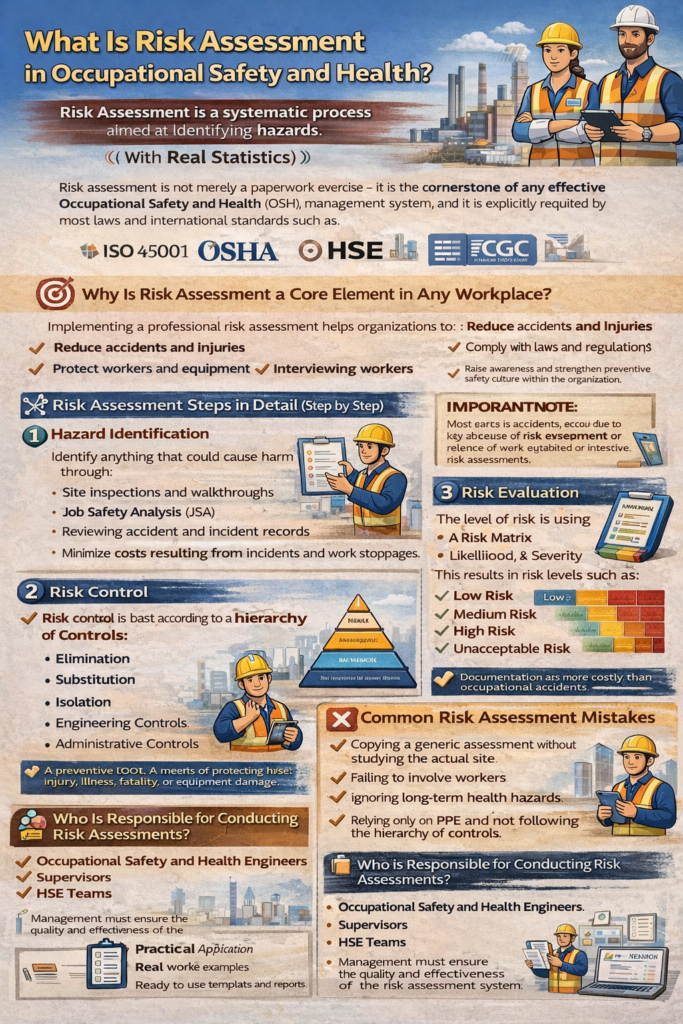
What Is Risk Assessment in Occupational Safety and Health?
Risk Assessment is a systematic process aimed at identifying hazards present in the workplace, analyzing them, evaluating their level of risk, and then implementing appropriate control measures before they lead to accidents or occupational diseases.
Risk assessment is not merely a paperwork exercise—it is the cornerstone of any effective Occupational Safety and Health (OSH) management system, and it is explicitly required by most laws and international standards such as:
ISO 45001
OSHA
HSE – UK
🎯 Why Is Risk Assessment a Core Element in Any Workplace?
Implementing a professional risk assessment helps organizations to:
Reduce accidents and injuries
Protect workers and equipment
Comply with laws and regulations
Minimize costs resulting from incidents and work stoppages
Raise awareness and strengthen preventive safety culture within the organization
📌 Important Note:
Most serious accidents occur due to the absence of risk assessment or reliance on weak, outdated, or ineffective risk assessments.
🛠️ Risk Assessment Steps in Detail (Step by Step)
🔹 Step 1: Hazard Identification
Identify anything that could cause harm through:
Site inspections and walkthroughs
Job Safety Analysis (JSA)
Reviewing accident and incident records
Interviewing workers
🔹 Step 2: Identify Who May Be Harmed and How
Examples include:
Workers
Supervisors
Visitors
Contractors
And determining the type of potential harm (injury, illness, fatality, or equipment damage).
🔹 Step 3: Risk Evaluation
The level of risk is calculated using:
A Risk Matrix
Likelihood × Severity
This results in risk levels such as:
Low Risk
Medium Risk
High Risk
Unacceptable Risk
🔹 Step 4: Risk Control
Risk control is applied according to the Hierarchy of Controls:
Elimination
Substitution
Isolation
Engineering Controls
Administrative Controls
Personal Protective Equipment (PPE)
🔹 Step 5: Documentation and Review
Document assessment results
Update risk assessments periodically
Review assessments when:
An accident occurs
Equipment is changed
Work methods are modified
❌ Common Risk Assessment Mistakes
Copying a generic assessment without studying the actual site
Failing to involve workers
Ignoring long-term health hazards
Relying only on PPE and not following the hierarchy of controls
Failing to update the assessment
👷 Who Is Responsible for Conducting Risk Assessments?
Occupational Safety and Health Engineers
Supervisors
HSE Teams
Management must ensure the quality and effectiveness of the risk assessment system.
🎓 Do You Need a Risk Assessment Course?
Practical application
Real-world examples
Ready-to-use templates and reports
Alignment with international standards
If you are:
A Safety Engineer
New to Occupational Safety and Health
A Site Supervisor
A Business Owner
Then you need a practical and applied understanding of risk assessment—not just theoretical knowledge.
👉 You can learn more about professional risk assessment training through the Balencia platform, which focuses on:
📝 Conclusion
Risk assessment is not a formal or symbolic procedure—it is:
A preventive tool
A means of protecting lives
The foundation of any successful safety system